Saturday, January 9, 2016

Magic Creatures on Silk - Humpback

The Humpback Whale


Until today there are 3 paintings in this little series Magic Creatures: Humpback, Nautilus and Sepia.

 "Humpback"
40" x 13" , silk, stitched

The world of the whales is the ocean – but how long still? The whale we know the most about is the Humpback whale. Nevertheless there are enough “unknown facts” which need to be de-coded.

Whales are mammals – no fish – and extremely intelligent, a social being with unbelievable skills and a very sophisticated communication. Did you know that they have dialects? And they can sing – at least various species and only the males. When you have heard them once underwater you will never forget this again!
I am not going to list all facts about humpbacks and other whales –  the Internet is full of information if you want to know more about these wonderful creatures.  I can only say that when I heard a humpback for the first time, diving on Maui, I could never forget that sound again and the fascination I feel for them.
Imagine that: these intelligent creatures are still hunted and killed, especially by countries which do not depend on the income of these killings at all due to their fortune, countries such as Norway, Iceland and Japan.

The ploys of the whaling lobby are incredible. Small and poor countries are bribed in order to buy their votes during the trade-offs  of the whaling commission and much more.
I feel sick continuously when I think about the greed and ignorance  of certain people, who sacrifice all and everything.
Nonetheless something amazing is happening again and again: although the whales seem to have something like a collective conscience and memory they are extremely gentle creatures, who forgive all those cruelties the human being is doing to them.  How else would you explain that specifically humpbacks are curious, seek to be near to the human, seemingly trying to communicate and behave completely peaceful while we can enjoy this incredible encounter of the 3rd kind? Nearly every wild animal tries to avoid the presence of man. A humpback could easily crash a boat and kill the swimmer who is near him…


There exist innumerable stories and reports about humpbacks and other whales which prove how sensitive and intelligent they are. One of the stories can be read here and here. It is a very moving story about a female humpback caught dangerously in a fishernet, divers who cut her out of it and how she thanked her rescuers.
This is also a very interesting article (ScienceDaily). It is about – more or less – brain cells, which can be found in whales as well as in humans and which play a big role regarding cognitive skills – with the bottomline that we still know too little about the true capacities of certain animals.


My biggest wish is that neither humpback whales nor all the other animals become a myth in the end as it happened to so many other species on this planet. Even if many things are exaggerated, their meaning twisted and adapted to the appropriate interests it is quite obvious that dead and quiet oceans would be something terrifying even menacing because this would be the same fate of mankind.
Today we have the Internet – everybody has access to information and no-one could argue with the excuse “I did not know”! Anyone on this planet is responsible for his immediate environment. Anyone should name the things which need to be changed. Small steps are necessary – those in your own home… we only have one world!


May the beautiful world we still have be conserved and nursed...

~~~

Monday, January 4, 2016

Silk Scrolls - The Weaver

Here is another chapter of my artwork: painted Silk Scrolls.
These scrolls are very decorative – the series is therefore called “Ornaments”.
Reminiscent of ancient Chinese or Japanese scroll paintings their construction yet is completely different and has been developed by myself. While traditional Japanese and Chinese silk scrolls are made from very thin painted silk, that is glued to paper which again is normally covered by patterned silk, my scrolls consist of 3 layers of fabric and no paper at all.

The middle piece is constructed like a quilt with a layer of very thin batting between the top layer which is the painted silk and the back. Headpiece and footpiece are normally made from silk as well, which has been fused to a thin layer of rayon fabric.


“The Weaver”
65″ x 21″, Silk Scroll


First the middle piece has been created. Starting with a detailed drawing, this has been tranferred to the silk (Habotai) and then painted. After this was finished, the batting was fused to the silk. In the next steps the headpiece and the footpiece were created, using stencils (my own) for painting the ornaments which were supposd to look like batik. This was meant as an hommage to the outstanding textile and batik work of southeast Asian countries such as Indonesia.


.
After finishing all these steps, all 3 pieces were sewn together, backing was added and then closed at the small side.
.
The last step was machine quilting the middle piece. This pattern should symbolize a heirloom, the one this mysterious young woman is working at. Therefore the title of this scroll: The Weaver. Her face should be reminiscent of all those female textile artists of southeast Asia who create crafts of extraordinary beauty and workmanship..


Different from the Chinese and Japanese painted scrolls where the dowels are glued to the paintings themselves I have created something different: the fabric has been sewn to the back in order to form a little sleeve so that the dowel can be pushed in but also removed again. This gives more freedom in regard of hanging this scroll. Thus it is also possible to mount it on stretcher bars instead, without damaging the painting and mount the middle piece on a stretcher frame with or without additional frame - see examples below:


~~~


Thursday, December 31, 2015

Krishna and Radha - Part III

The Path of the Tantra...


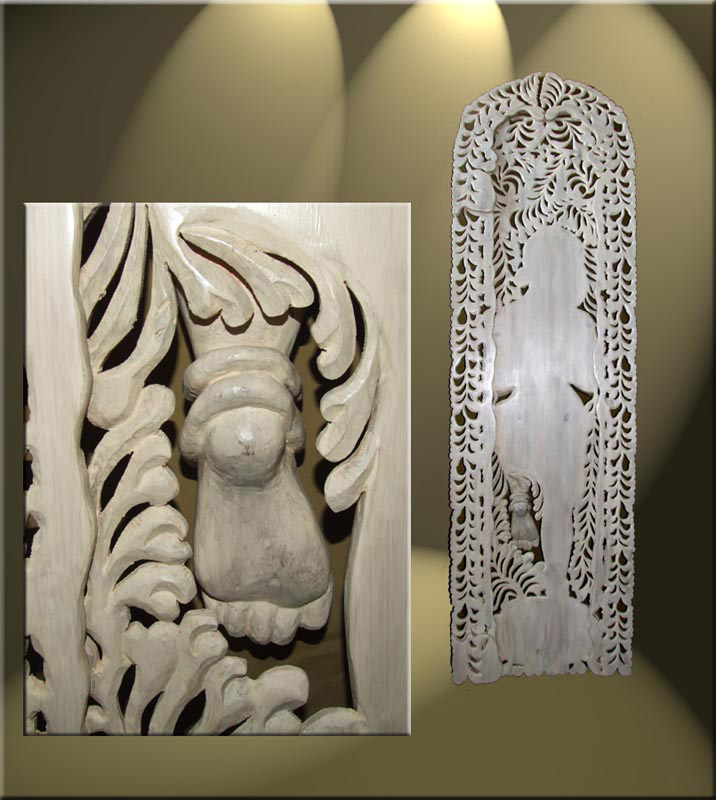
As already mentioned before the bas-relief consists of 3 large panels. Each of these panels could be mounted on a wall for itself after removing simply the brass hinges.


The reverse sides of the panels have been processed neat and clean - as you can see in the image below - so that you could even place the middle panel into open space (securing it for a stand-alone of course.)


The image below shows a unique feature on the reverse side of the panel:
the foot of the sculpture has not been worked as a bas-relief but as full sculpture. For this the ornament level had to be opened up.


The following images show more details. The figure below is a so-called "Apsara", which plays a significant role in the Indian mythology as well as in other Asian countries. In Hindu as well as Buddhist mythology these female characters are half human and half devine and live as female spirits of the clouds and waters.

"In Indian religions, Apsaras are beautiful, supernatural female beings. They are youthful and elegant, and superb in the art of dancing. They are often wives of the Gandharvas, the court musicians of Indra. They dance to the music made by the Gandharvas, usually in the palaces of the gods, entertain and sometimes seduce gods and men. As ethereal beings who inhabit the skies, and are often depicted taking flight, or at service of a god, they may be compared to angels." (Wikipedia)


In the mythology of the Khmer (Cambodia) the apsaras had a special value as celestial dancers. On the huge temple compound of Angkor Wat you can still see and admire up to 2000 ! sculptures of these temple dancers all carved in stone.


The portrayal of the apsara as more or less erotic dancer should be reminiscent of the displays on the temple compound in Khajuraho in India. There the Tantric path is considered to be the most beautiful and challenging spiritual path to the inner self and is represented by hundreds of erotic sculptures.


"Tantra is that Asian body of beliefs and practices which, working from the principle that the universe we experience is nothing other than the concrete manifestation of the divine energy of the godhead that creates and maintains that universe, seeks to ritually appropriate and channel that energy, within the human microcosm, in creative and emancipatory ways." (Wikipedia)
Taking the path of the Tantra means to open the borders of the imprisoned self towards the world through intimate encounter with the different. Tantra teaching says that the sexuality is only a means of mind-expanding. The background is religious: Shiva, Vishnu and Brahma create with their Shaktis (the concept or personification of divine feminine creative power) the world.


~~~
.
.
.
.

Related Posts Plugin for WordPress, Blogger...